By clicking “Accept all cookies”, you agree EOC Institute can store cookies on your device and disclose information in accordance with our Cookie Policy.
Accept all cookies
Necessary cookies only
Necessary cookies
Customize Settings
Cookie Settings
Our website may need to store or retrieve information on your browser in the form of cookies. Used mainly to make the site work as needed & give you a more personalized web experience, this information might be about you, your preferences, or your device. Because we respect your right to privacy, you can choose not to allow some types of cookies. Click on the different cookie settings below to learn more and to manage your preferences. Please note that blocking some cookie types can impact your site experience & the services we're able to offer.
Advertising Cookies(?)
Enables storage related to advertising
Analytics Cookies(?)
Enables storage related to analytics (for example, visit duration, page views, etc)
Functional Cookies(?)
Enables storage that supports the functionality of the website or app such as language settings
Personalization Cookies(?)
Enables storage related to personalization such as video recommendations
Security Cookies(?)
Enables storage related to security such as authentication functionality, fraud prevention, and other user protection
Strictly Necessary(?)
REQUIRED: Allows our website to function correctly and cannot be disabled. For login authentication, form submission, basic security, admin, hosting, etc
How Meditation Builds Self Control, Willpower, Discipline – EOC Institute
How Meditation Builds Self Control, Willpower, Discipline
How Meditation Builds Willpower, Self-Control, & Discipline
The Power Of Willpower
Willpower fuels success.
Whether it's a "shiny" diploma, a "rockin'" body, an "eye popping" bank account, a "spring out of bed everyday" fulfilling career, a "change the world" business, "picture perfect" health, or any other goal — you must train yourself to "do the things you don't really wanna' do but know you needta'."
"Should I stay glued to the couch all afternoon or hit the gym? Should I Netflix (for yet another night) or make some new friends at that local Meetup? Should I continue my infinite social media scroll or (finally) get started on learning how to code? Should I finance this brand new car or pay cash for something older? Should I indulge in this brownie or hold off until I have achieved beach-bod status? Should I play another two hours of Fortnight or break-ground on my genius startup idea?"
Without the self-discipline to put in the "hard yards" today, the dream of a better tomorrow will always be just that. A dream. Luckily, we aren't born with a set amount of willpower. All the great ones had it, you can too.
Before we tell you the secret to magnifying your own inner strength, it's important to understand what makes the "high achieving" brain so unique.
The Marshmallow Study
As one of the most important psychological examinations of the 20th century, the "delayed gratification" marshmallow study offers deep insight into the inextricable link between willpower and success.
In 1972, Stanford university researchers (Mischel et al) put the willpower of 600 preschoolers to the ultimate test. One by one, the instructor had the four and five year olds go into a room with nothing but a chair, a desk, and a yummy marshmallow waiting for them on a plate. The little ones were given two options. They could either eat the marshmallow now, or if they waited until the researcher came back into the room (usually after fifteen minutes), they could have two.
Of course, once the door was closed, many of the children did their best to wait it out. Some would cover their eyes, squirm, spin their chair in circles, bounce in anticipation, turn the other way, kick the desk, sing songs — one little guy even pet the marshmallow like a stuffed animal. It turns out that watching preschoolers resist temptation is quite the entertainment.
The Power Of Delayed Gratification
Of the 600 children who took the test, only about one third (≈200) were able to wait for the second marshmallow, the full fifteen minutes. Of the other two thirds, some made it one minute, others five or ten minutes, and so on. Like a self control "IQ score," the number of minutes before "caving-in" was each child's willpower grade.
Here's where it gets really interesting. To see where the preschoolers ended-up in the world, Mischel and colleagues did three decades worth of follow-up studies. Here's what they found:
The children who delayed gratification the longest, later on as adults, outperformed the "weak-willed" children on every single test the researchers threw at them. They had higher SAT scores, higher income, more education, more friends, fewer bad habits, cleaner criminal records, better stress scores, and so on.
On the results, study lead author Dr. Mischel said: "If you can deal with hot emotions, then you can study for the SAT instead of watching TV, and you can save more money for retirement. It's not just about marshmallows."
Willpower Can Be Strengthened Like A Muscle
"So, to be successful in this world, I need willpower. Got it. Do I need to jump in a time machine and force mom and dad to give five-year-old-me an extra helping of discipline?"
While the marshmallow study's findings imply that willpower is set from an early age, that's clearly not the case. Whether through good parenting, good genes, or plain good luck, the kids who aced the marshmallow study simply learned to delay gratification at a young age. Good for them.
If human willpower peaked in preschool then we would all be, as adults, watching Pokemon and Spongebob cartoons 16 hours a day in our PJs, subsisting on a highly nutritious diet of Cocoa Puffs and Lucky Charms, throwing "I want this shiny new toy!" tantrums at our heart-attack-prone elderly parents, and so on. You get the idea.
Thankfully, willpower is never set in stone. Not at 5. Not at 55. Regardless of age, experience, and genetics, willpower can be strengthened like a muscle.
And the lead author of the marshmallow study, Dr. Mischel, agrees: "The ability to delay immediate gratification for the sake of future consequences is an acquirable cognitive skill... Even young students understand that they can change how they think and how they plan in ways which give them greater control over what they can do, what they can learn, and what they can become... Once you realize that willpower is just a matter of learning how to control your attention and thoughts, then you can really begin to increase it."
We Can All Change
You've been smoking since you were a teenager? Forty-year old you can quit that "sh#%." You've been a couch potato for the last thirty years? No problem, you can run a marathon six months from now. You've been working a dead-end job your whole adult life? No sweat, you too can have a "spring-out-of-bed-everyday" fulfilling career.
The world is full of "lazy bums" turned Ironmen/Ironwomen, "8th grade dropouts" turned mega-moguls, "lethargic loafers" turned hard workers, "round-the-clock-junk-food-eaters" turned certified nutritionists, you get the idea. No matter how badly life has beaten you down, no matter how deeply you are "set" in your ways — you can change for the better. Mind is the builder.
Why Meditation Is The Secret To Building Willpower
"Ok, transforming my life is definitely possible. Thank you for opening my eyes to that. But probably not gonna' happen. Why? Because weakness rules my world today. What's the secret to hitting my willpower switch?"
To get the light back in your eyes, you need to fortify your inner world. And the best way to do that? Meditation. Understanding meditation's meteoric impact on self-control starts with that big beautiful dome sitting atop your (soon to be) chiseled shoulders. Here's how it works:
With the goal of pinpointing willpower's home address (in the brain), Caltech neuroscientists (Hare et al) had 37 dieters rate 50 pictures of food on their level of "tastiness" and "healthiness." The dieters were then hooked up to brain imaging technology and instructed to choose between a food they rated as "neutral" (e.g. wheat thins, granola) and either a "tasty" food (e.g. cheese cake, chocolate) or a "healthy" food (e.g. broccoli, celery). What did they find?
When the dieters made health-driven (rather than taste-driven) food choices, a section of their brain called the "dorsolateral prefrontal cortex" (DL-PFC) lit up like the sky on 4th of July. What does this mean? This bundle of cells buried deep behind the forehead is willpower's home in the brain.
While the Caltech researchers are now working on "special techniques" to strengthen the DL-PFC, they might want to check the neuroscientific journals. That is, doctors have already shown how to make this highly disciplined brain region big and strong, a technique that doesn't require any kind of mental gymnastics or year 2100 technology. It's called meditation.
How Meditation Molds A "Willpowerful" Brain
After imaging the brains of newly minted meditators before and after an 8 week mindfulness course, Italian neuroscientists (Tomasino et al) made a number of amazing discoveries. Among their findings, the meditators fortified their dorsolateral prefrontal cortex(es). Sound familiar? Yep, that's the willpower region of the brain. The ancient mind practice pumps it up like Hans and Franz.
While meditation's "inner-world" bulletproofing benefits have been known and written about for ages, seeing it confirmed (using the latest scientific gadgetry, no less) is a whole new ballgame. For those of us seeking a better life (aren't we all!), this is great news.
Through the incredible power of neuroplasticity, meditation helps you "do the things you don't really wanna' do but know you needta'. From exercising more, to eating better, to kicking bad habits, to learning new skills, to achieving your dream(s), meditation's "inner-strength" magnification improves your life on all levels.
More Ways Meditation Tops-Up Willpower
#1 — Urge Surfing "Weak-Sauce" Thoughts: By observing our mind without judgement, meditation helps us realize that we are not our "I can do this tomorrow" procrastinations, we are not our "it's ok to give in just this one time" urges, and we are not our "gotta' get my fix right now" cravings.
Like waves crashing upon the shore, our "weak-sauce" thoughts come and go. No wave is any more important than the one before it or the one after. In time, mindfully urge surfing our weak-willed thoughts as they surface, peak, and crash to the shore can be more wonderful than a day at the beach.
Each time we tell our urges and cravings "like any thought, you too shall pass" — our "wall o' willpower" gains a new mindful brick. Each time we tell our procrastinations "I'm doing this today, not tomorrow!" — our wall strengthens. Eventually, we find ourselves living in a "higher thought" castle, where thoughts of "giving up & giving in" can't penetrate our thick, mindful walls.
#2 — Becoming A "Do-It-Yourself" Master Mind Mechanic: As we drive down the road of life, thoughts of "surrendering to temptation" can grind our transmission, thoughts of "giving up" can choke our radiator, and thoughts of "giving in" can clog our oil filter. Soon, our "weak-willed" thoughts have left us stranded on the side of the road calling for a AAA tow truck.
As the very best way to examine, diagnose, and repair our "broke-down" thoughts, meditation transforms us into a "do it yourself" master mind mechanic, blue jumpsuit and all. With this wonderful superpower, if we hit a bump in the road (stress, anxiety, depression, etc.) or need to replace a defective part (being a "quitter," bad habits, procrastination, etc.), we can fix it ourselves. On the spot. Lifetime warranty included.
Mind Is The Builder
So, the next time you're on the fence about eating a salad or inhaling a sundae, going to the gym or laying on the couch, breaking ground on your startup idea or scrolling your social media feed — remember the infinite power within. Speaking of:
"When you feel like hope is gone, look inside you and be strong, and you'll finally see the truth, that a hero lies in you..." As the famous lyrics so eloquently put it — A "willpowerful" hero lies in you. Awaken them with meditation.
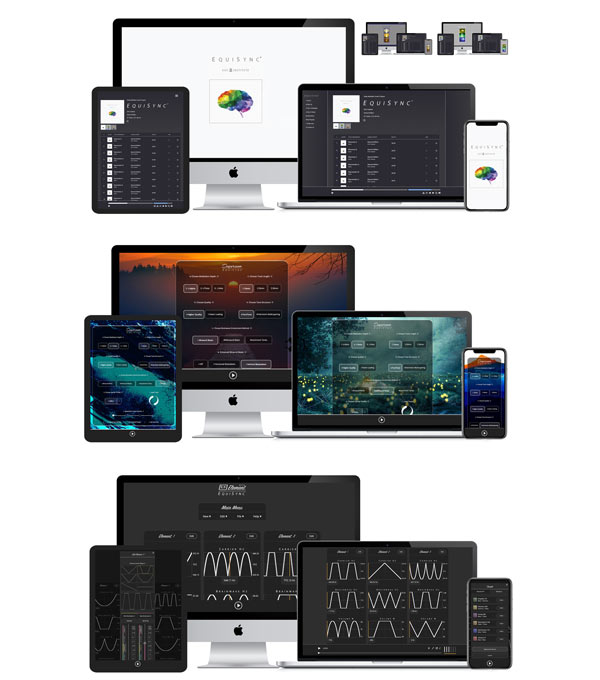
Using safe and highly effective sound technology, all EquiSync programs are designed to carefully ease the listener's brainwaves into a state of deep meditation, opening the door to the ancient mind practice's limitless benefits much faster than the traditional route. You can learn more about how it works from the links below:
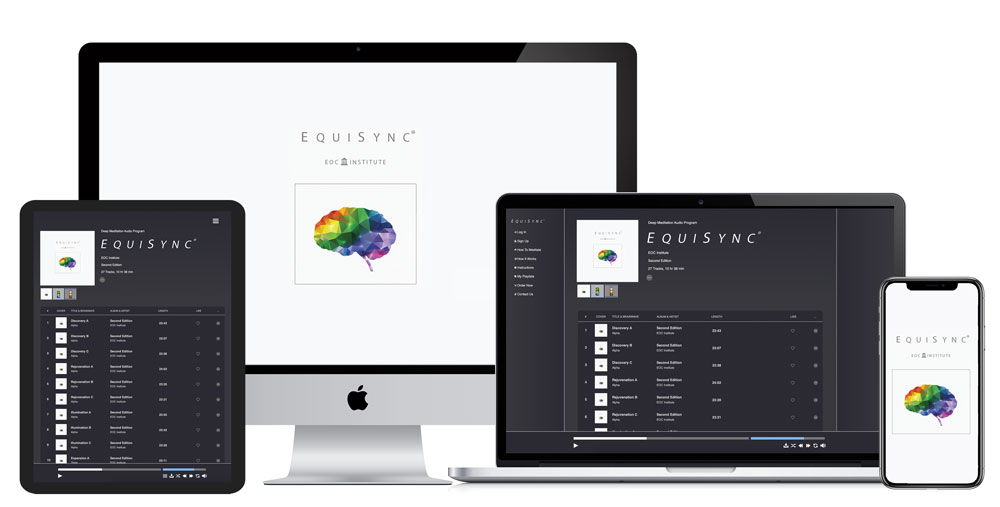
Over a decade ago, we released our highly popular brainwave system, EquiSync Classic. Since then, we have upgraded the program continually, ensuring our deep meditation audio technology stays on the cutting edge. The latest version of the program includes seven-plus hours of highly optimized downloadable MP3 audio tracks (that you own forever). While Deepereum may be the more robust system of the two, many people, especially those new to the technology, prefer the elegant simplicity of EquiSync Classic. Sign Up
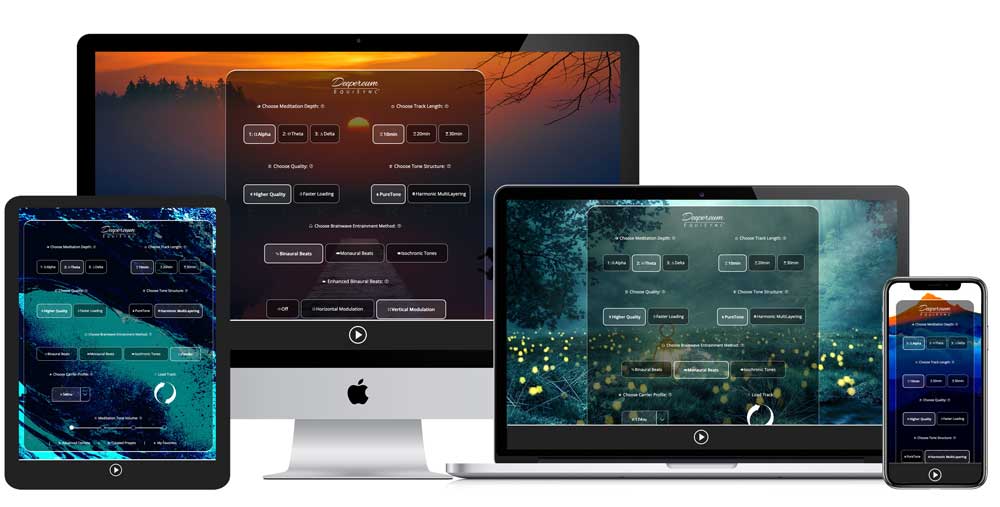
EquiSync Deepereum is the first program on the market that allows you to precisely build, customize, & curate a meditation audio track to your liking. With the program's powerful configuration options (brainwave frequency, entrainment technique, session length, audio quality, soundscape, & more), Deepereum opens the door to thousands upon thousands of potential track combinations. While intermediate to advanced users really love the program, Deepereum is built for everyone. Sign Up
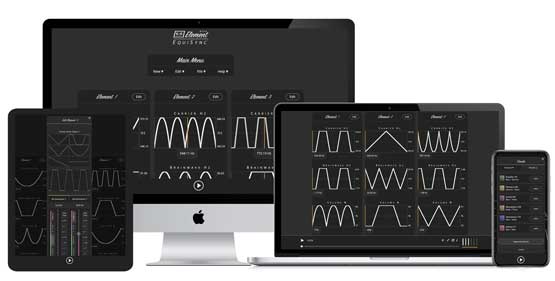
EquiSync Element is the ultimate meditation tool. With it you can quickly and easily create a multilayered, harmonically resonant meditation soundscape — with the purest frequencies. Built with maximum flexibility in mind, there is no limit to what you can create. While advanced users really love the program, Element's powerful auto-generation tools make the program accessible for everyone. You are encouraged to explore EquiSync Element's never-ending options to discover what works best in your practice. Sign Up
While we have outlined one basic philosophy / form of meditation in the links below, if you already have a proven meditation technique — then we encourage you to combine & enhance it with our audio technology. EquiSync uses sound to deepen the meditative state no matter your chosen technique.
How can meditation benefit your life? Our highly referenced, highly backlinked "benefit of meditation" articles are known for their in-depth research & inspirational tone. A few good reads are linked below: